
Online reviews & AI: how to get insights into trends and create professional responses?
In today's digital age, online reviews are not just feedback but a powerful tool that you can leverage to understand customer sentiment and improve services. As you accumulate thousands of reviews across various platforms, manually analyzing them becomes an unfeasible task.
This is where Artificial Intelligence (AI) steps in to transform raw data into actionable insights and professional responses, enabling businesses to stay ahead of trends and maintain positive customer relationships. But how do you get started? What analysis can you do? How do you handle reviews?
In this blog, I’ll answer those 3 questions and will help you get started yourself by giving live samples and prompts!
Getting started: How do you get all your reviews in an easy export?
So let’s assume you have gathered a few thousand reviews over the years on your Google profile. Analyzing or copying/pasting them manually would take ages, so how can you download them in CSV or a similar format?
A good option is to use a tool like https://exportcomments.com/ to make an export. The first 100 reviews are free of charge, so I recommend exporting them all, since more data means you have better insights.
Of course, you can export reviews from other platforms like Facebook, Amazon and Yelp to include in your analysis. Our dataset for this blog includes 2.744 reviews for 1 garden centre, and the oldest one is from 2017. That should be sufficient to work with!
Sentiment analysis and trends
Since all reviews have dates and times, we can do a sentiment analysis and ask Chat GPT to highlight recent trends, positive or negative. It would be good to understand if ratings go up and down, so let’s ask for a graph with the average rating per quarter, starting in Q1, 2020, so we ask a clear question to Open AI:
Can you make a graph with the average rating per quarter, starting in q1 2020?
The output is a nice graph showing the trend of all reviews from Q1, 2020, till Q2, 2024:
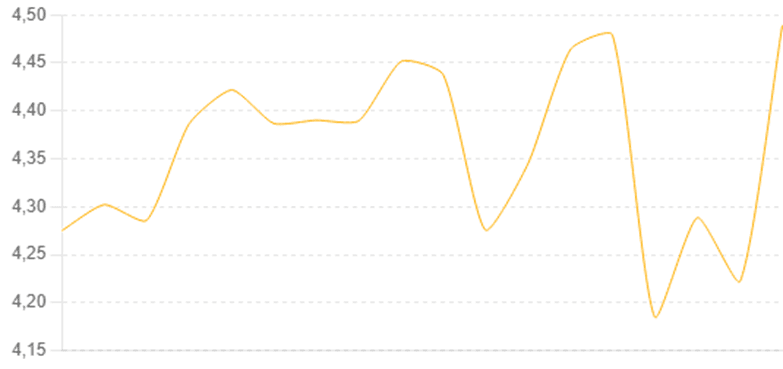
You can see the reviews are pretty stable, around 4.4 stars, but there’s a decline in ratings in the 3rd quarter of 2023, which, of course, makes us wonder what happened. But before we zoom in on this period, we have to see if the number of reviews during that period is in line with the average over the years. Otherwise, we would draw conclusions based on just a few negative reviews.
The numbers:
Average per quarter from 2020 & onwards: 94.3
Reviews in Q3, 2023: 58
So, the number of reviews in that specific quarter is pretty low compared to the average. If we ask Open AI to give us the negative ones and to summarise the complaints:
1-star (September 26, 2023): Beautiful flowers but very unfriendly at the counter.
2-star (September 24, 2023): Ordered pancakes at 2:56 PM, and despite an initial delay, service was slow.
2-star (September 14, 2023): Refused to replace a dripping bouquet at the cashier.
2-star (August 24, 2023): No comment provided.
So, 2 of the complaints originate from bad customer service – perhaps something to improve with some training via the HTA or GCA? We can conclude that the drop in reviews is caused by only 4 customers so it’s not a trend to worry about.
Segment issues per product group or area
Three negative reviews having an impact on the overall rating in Q3, 2023 were related to bad customer service, and 1 hasn’t had any context. But how do customers rate other departments and areas of the garden centre? For this store, we identified the following main areas:
Café
Christmas
Flowers
General
Plants
We can ask our Chat GPT assistant to make a breakdown of reviews in these 5 categories. To make sure AI doesn’t make the wrong assumptions, I usually add lines like this to the call I make:
If it’s not clear if the review relates to one of these 5 areas, flag it as “General”
If a review is about 2 or more areas, flag it as “General”
If you don’t do that, an AI tool might follow its own path and give you false information. It’s important to give strict guidance and set your expectations. The outcome based on the 500 most recent reviews:
Café: Average rating of 4.31 based on 13 reviews.
Christmas: Average rating of 4.00 based on 14 reviews.
Flowers: Average rating of 4.00 based on 6 reviews.
General: Average rating of 4.39 based on 345 reviews.
Plants: Average rating of 4.27 based on 15 reviews.
The difference between Christmas and the rest of the reviews would mean there’s room for improvement in the Christmas department. We can ask to analyse the Christmas reviews to get an idea of what to improve.
Actionable feedback
Data and stats are interesting, but it’s better to figure out what actionable feedback your customers have given in their reviews. This query will result in a list of things you can discuss with your team since it’s a practical list with improvements for the Christmas department:
Lack of variety and stock of Christmas items
Customer service too busy during weekends
Suggestion to have more events and workshops
Through the interaction with AI, we don’t have to read 14 reviews for the Christmas area manually; we just get a summary of what to improve.
Of course, we can do that for the entire centre and all reviews as well, so we asked to summarise the last 100 1—and 2-star reviews and give actionable feedback.
The outcome:
There are repeated mentions of unhelpful or unfriendly staff. Prioritise training to enhance customer interaction and ensure staff are approachable and knowledgeable.
Some customers have complained about limited variety and perceived stagnation in product offerings. Regularly refreshing the stock and ensuring high-quality products could address these concerns.
Issues with pricing, including overcharging, have been noted. Review pricing strategies and ensure pricing transparency to build trust and avoid customer dissatisfaction.
Comments about facility-related issues such as cleanliness and organisation have surfaced. Improving the upkeep and presentation of the store could enhance the overall shopping experience.
There are complaints related to specific operational aspects like beverage temperature at the cafe. Paying attention to these small details can significantly impact customer satisfaction.
The owner of this store can use this to discuss improvements with his team. The customer is always right (even if he isn’t), so the feedback is very valuable. And by using Chat GPT to analyse all data, we don’t have to spend hours on making summaries and report.
Who doesn’t want to shop at a store with helpful & knowledgeable staff, a wide variety of products with correct pricing, in a clean environment and getting served a hot coffee or cold coke?
Respond to reviews
Another way to improve your customer satisfaction is to reply to reviews customers have written. If you want to do that, there are a few things to consider:
The tone of voice of the responses should match your brand
The responses should be accurate
1 silly mistake can ruin your online reputation
So how can we make sure that an AI tool doesn’t cross the boundaries set? You can simply give instructions to handle this. The Rundown published a list of 6 things to keep in mind when writing a prompt for Chat GPT, which is pretty useful:
Task: Clearly define what you want to do.
Context: Provide relevant information about your situation.
Examples: Include a training set to refer to.
Persona: Explain your role in the company.
Format: Be specific about the expected outcome.
Tone: make sure it uses the write spelling and tone of voice.
To help you, I configured a sample of a prompt:
I’m the customer service agent of a garden centre and have to manage online reviews. Write a response to reviews on online platforms based on my input. Reply in a professional yet personal way and use the customer name in reply. Keep replies to the point. Don't use an introduction or end, just write the reply. Reply in British English. Maximum of 60 words per reply.
If the review is 1 or 2 star, never say the customer is wrong. Thank them for giving feedback. If 1 star, invite customer to come to centre and ask for the manager to discuss complaint. Bring the receipt. Hope we can make it up. If 2 star, thank customer for feedback and that we will use it to improve the business. If 3, 4 or 5 stars, thanks for feedback and hope to see them back soon.
For a simple task, this prompt is sufficient. You might have noticed that the examples are missing – we’ll come back to that in a minute. If this is the prompt, we can do some testing with real customer reviews. Let’s start with an easy one from Gene:
Good selection of plants. Not a rushed environment, friendly staff, good quality plants. A little pricy but you will find tomato plants that you will not find any where else. Heirloom tomato plants were a great find.
And the reply we generated:
Thank you for the feedback, Gene! We're glad you enjoyed our selection of heirloom tomato plants and found our environment welcoming. We acknowledge your concern about pricing and will take this into account as we strive to improve. We look forward to seeing you again soon!
I think the reply is pretty professional and it ticks the boxes, doesn’t it? The trick, however, is to see how the replies to complaints are since that’s more complicated. Two examples:
Bought the purple basket with the pink one together 10 days ago and it’s almost dead, ask for exchange and they said they don’t guarantee.
Obviously, this was 1 star review from Jane, so let’s check the reply:
Thank you for your feedback, Jane. We're sorry to hear about your experience. We strive to ensure our products meet high standards, and we take your concerns seriously. Please come to the centre and ask for the manager with your receipt, and we'll do our best to resolve this for you. Hope we can make it up to you.
And another complaint, from Adam this time:
I ordered some saskatoon bush plants through in the fall and confirmed the order in the spring. When the plants didn't arrive I called to see why and was told they didn't arrive. I told them I'd like to call the nursery and was told "Don't call them" - always a reason to call. I called the plant nursery and they said no order was placed. Thanks for nothing
And the reply generated:
Thank you for sharing your experience, Adam. We apologise for the confusion regarding your order and the inconvenience it caused. Please come to our centre and ask for the manager with your receipt. We value the opportunity to discuss this further and hope to make things right for you.
As you can see, the replies are written in line with our initial instructions. The only thing you have to do, is to monitor the reviews on your profiles. Simply copy the review to generate a ready-to-go reply.
What usually happens is that you make some tweaks to the replies generated. To improve the output quality, you can upload a file with samples to OpenAI so they can be used to understand how you want to have the responses. That’s where the examples mentioned in the first part of this paragraph come in!
The examples, or a training set, are really helpful. To use them, simply create a Word file with a bunch of reviews and responses and upload it to your OpenAI account. Once done, you can add a line to the initial prompt:
Reply to reviews in line with the samples provided, but don't replicate them literally.
Again, AI systems including Chat GPT can take things literally and you don't want to have the same response over and over again.
AI & reviews: a lot to learn
The importance of efficiently managing and learning from customer feedback cannot be overstated since they are the ones shopping in your centre and paying the bills! As explained, having an export of customer reviews helps you to get deeper insights into customer sentiments and trends. By utilising AI and data analysis techniques, you can easily pinpoint areas for improvement.
The importance of responding to reviews with a professional and personal touch underscores the ongoing dialogue between your business and consumers. Even negative feedback, when handled correctly, can be turned into an opportunity for improvement.
This holistic approach to managing reviews—gathering data, analyzing trends, providing actionable insights, and engaging with customers—ensures that businesses remain adaptable and customer-centric in their operations. Simple AI tools like OpenAI/ChatGPT are here to help you!