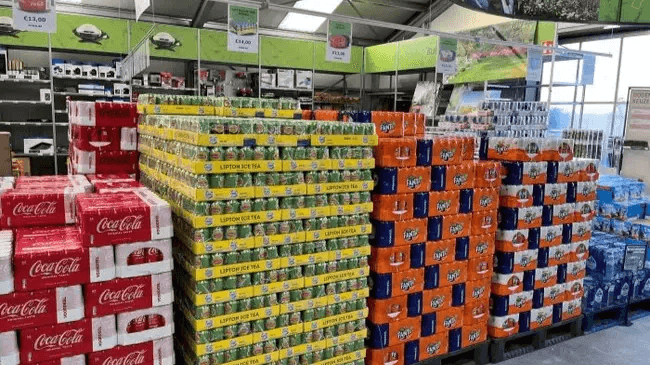
Soft drink sales in garden centres - an inside look at consumer behavior
Many foreigners from the industry have been visiting Dutch garden centres and noticed pallets with soft drinks stacked in a corner and wondered how that was working, practically and financially. Why would you do that? What’s the added value to your business? And are customers buying it?
Before we continue, I have to admit that the numbers fluctuate heavily across garden centres, since the sales of soft drinks are dependent on competition and the location. In an urban location with a lot of supermarkets, the necessity to buy cheap trays of soft drinks is lower than in a location more in the countryside, with less supply and competition.
Therefore I used the averages of 3 medium-sized garden centres – according to Dutch standards - and will give you some more guidance on this phenomenon. And of course, I will answer the questions of the first paragraph while doing that!
What’s the story behind soft drinks in garden centres?
The annoyance in the garden industry has grown over the years as more and more supermarkets started to sell plants. Even worse, during the Covid lockdowns garden centres were closed while supermarkets started to expand their plant offerings!
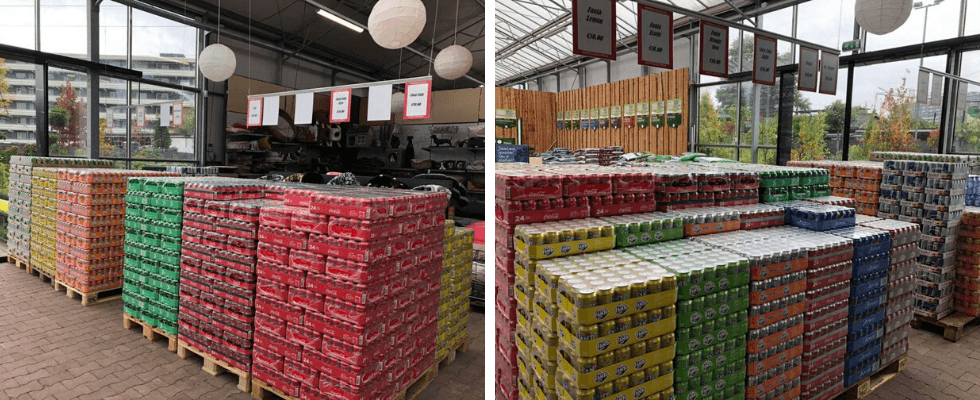
Soft drinks at GroenRijk Tilburg - photo made by GroenRijk Tilburg
Since the EU is an open market, some trading companies started importing soft drinks to the Netherlands (and Belgium) to compete with supermarkets on their own playing field. If you can sell plants, we can sell soft drinks!
The general idea:
Pricing is lower than in supermarkets due to cheap imports, but margins are also thin. Supermarkets have to buy from the brand directly, which has a lot of negotiation power to keep margins on their end.
Good to know if you’re not from the EU: you can simple shuffle products around the EU without tariffs. So what’s happening is that traders buy it in a country with lower prices and bring it to the Netherlands & Belgium, where prices are higher.
Sales per tray, no single cans, to keep logistics simple and increase transaction value
It’s a recurring buy for most customers so footfall goes up
There’s plenty of space in most garden centres to do this, while it’s often pretty scarce in supermarkets
Spoiler: business-wise it makes sense since the “soft drinks” group is now often in the top 3 (!) of suppliers to garden centres, based on revenue. Pretty impressive, isn’t it? But does it help to generate footfall, since revenue itself isn’t the only thing we need, we also need customers who buy other stuff with an actual profit margin on it.
Why I don’t like it
Personally, I don’t like it since you go to a garden centre for a lot of reasons but not to get bombarded with cheap soft drinks. It degrades the shopping experience back from a plant specialist to a cheap version of Aldi. Furthermore, consumers only come as long as it’s cheaper than elsewhere, so it’s highly competitive. On top of that, my girlfriend is a dietician, so I’m educated that soft drinks are simply not healthy, including the zero or light versions.
Yet, many of our customers are doing it and it’s a revenue generator, so we can safely assume my opinion doesn’t matter in this case. Time to put my opinion aside and to check the numbers!
The big picture
For this analysis, we combined transactional data of 2024 of 3 garden centres, medium-sized in the Netherlands, so approx. 7,000 to 10,000 square meters. I used Claude AI to slice & dice the data and to get the information I present below.
The data tells an interesting story. Out of 243,428 total transactions, 7,171 included soft drinks - representing approximately 2.9% of all purchases. While this might seem modest at first glance, these beverage-including transactions pack a significant punch in terms of revenue.
What’s flying off the shelves?
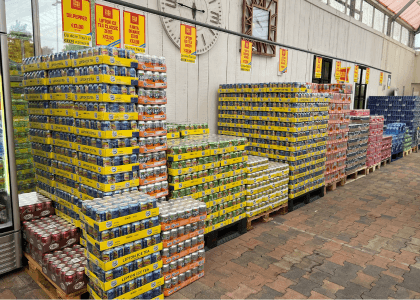
Soft drinks at GroenRijk Maasbree - photo by GroenRijk Maasbree
The top-selling beverages reveal some interesting consumer preferences:
Coca-Cola Zero leads the pack with 1,210 trays sold across 832 transactions. A pallet has 99 trays so that’s almost 13 pallets of Coca-Cola Zero in 1 year, as an average per garden centre.
Regular Coca-Cola follows with 918 trays across 638 transactions. That’s a lot of sugar!
Fanta Orange rounds out the top three with 322 trays sold
It’s also interesting that the average transaction that included soft drinks has 1.46 trays, so almost half of the customers buy 2 trays while buying soft drinks at their local garden centre.
Transaction patterns
Perhaps the most revealing insight is how soft drinks fit into larger shopping patterns since we want people who come for the soft drinks to buy more products.
And guess what: that’s actually working quite well.
Of the 7,171 transactions containing soft drinks, only 1,178 were beverage-only purchases.
A whopping 5,993 transactions included other products, with an average of 3.56 products per mixed transaction
The average transaction value for orders containing soft drinks is €39.63, since a tray is about €15 each and the average is 1.46 trays, the upsell is just over €16 per transaction.
From a business perspective, these figures are highly interesting since it means that most customers are buying more than just soft drinks.
The question we can’t answer yet is how many people were coming primarily for other products and grabbed a tray of soft drinks on their way out, or the other way around.
The only indicator we can use for this is to zoom in on loyalty card data. Since we can assume that customers with a loyalty card would go to their favourite garden centre regularly anyway, we can state that they won’t come for soft drinks only.
If we focus on this customer segment, which I did for 1 individual store, we have mind-blowing figures:
2,341 transactions with soft drinks are recorded for loyalty card holders
Only 16 of them had soft drinks included
Further research would be helpful, like personal Q&A’s, to analyse this specific question, but it would be safe to say that most loyalty card holders are not coming to a garden centre to buy soft drinks. These customers are buying it while there.
Revenue Impact
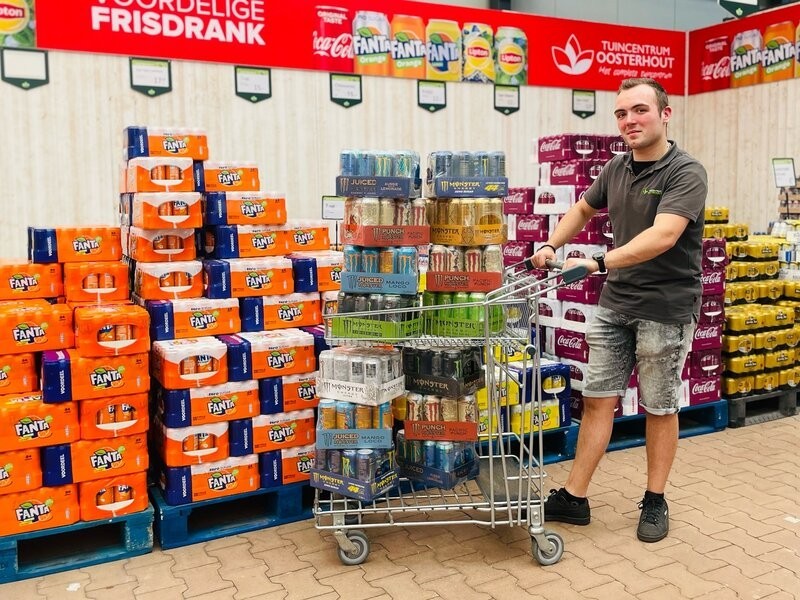
Soft drinks at Tuincentrum Oosterhout - photo by Tuincentrum Oosterhout
The revenue data tells a compelling story about the role of soft drinks in overall sales:
In mixed transactions (those containing both soft drinks and other products), soft drinks accounted for 43.10% of revenue (average per store of €122,471)
Other products in these transactions generate 56.90% of revenue (€161,686)
Total revenue from these mixed transactions reaches €284,157
Transaction Value Distribution
The average transaction value for transactions that included soft drinks, is in line with the general figure in the garden industry, which is somewhere between €30 and €40:
The sweet spot appears to be in the €20-50 range, representing 42.0% of transactions
30.3% of transactions fall in the €10-20 range
Higher-value transactions (over €50) make up 23.3% of sales
Only 4.4% of transactions are under €10, which makes sense, since barely any tray is available for under €10 anyway
Final words about soft drinks in garden centres
My conclusions based on the data I checked:
With most soft drink purchases being part of larger transactions, there’s a clear opportunity for strategic product placement and cross-promotional activities. The location of your pallets of soft drinks play a key role in this, so don’t put them next to the entrance; make it an IKEA adventure to find it!
The strong performance of sugar-free soft drinks suggests consumers don’t want to buy drinks that contain sugar. Stay away from the word “healthy”, however!
Soft drinks appear to be complementary products that contribute to larger basket sizes, with most transactions including multiple items, and can drive new customers to garden centres, which is what we obviously want.
The analysis suggests that soft drinks aren’t just an afterthought for garden centres anymore: they’re a strategic category that can drive both direct revenues and draw new customers to your store.
So financially, it makes perfect sense to ignore my opinion and to create a little corner in your store that looks horrible but works like a charm!
NB. Good to know: the stores on the photo are not the ones I used for the analysis.