
How to Avoid Plant Photo Copyright Claims and $600 Settlement Demands
Almost everyone in the garden industry has seen letters like this: you published a photo on your website and suddenly receive a letter asking you to prove that you have a valid licence for it. If you can’t, you’re presented with a settlement demand that can easily be $600 or more for a single photo.
How does this work? Is it lawful? And, more importantly, how can you avoid getting these claims for simple plant photos?
How These Companies Work
Familiar names in this “industry” are Visual Rights Group, Permission Machine, Copytrack and PicRights.
Visual Rights Group itself was previously called Permission Machine. In 2024, Visual Rights Group announced a merger with Copyright Agent, another company active in the same field. The companies use technology to find photos online that may be used without a valid licence.
They typically work on behalf of photographers or photo agencies. Their software scans websites, matches images against their clients’ photo libraries and identifies possible unlicensed use.
If they find a match, you may receive a letter containing a screenshot of the image on your website, a request to provide your licence and a proposed settlement amount.
Visual Rights Group is not a law firm. It describes itself as a legal-tech company that handles copyright enforcement for photographers and agencies. Its stated goal is to resolve these cases before they become lawsuits.
That distinction is important. The first letter you receive is normally a copyright claim or settlement proposal, not a fine handed down by a judge.
For the photo agency, this type of enforcement can be attractive because much of the detection process is automated. For the enforcement company, handling large numbers of claims also makes the process scalable.
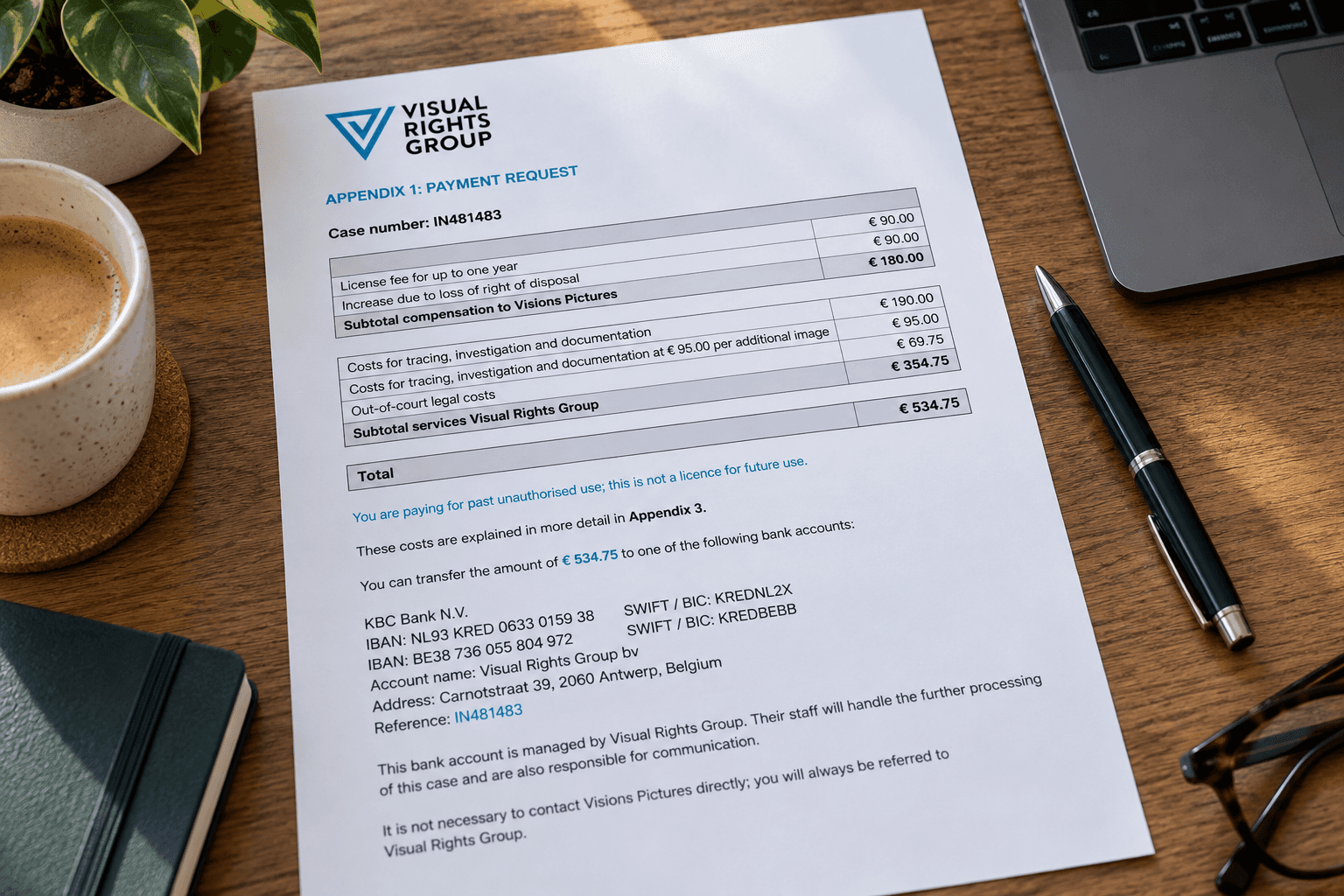
As an example: you receive the settlement proposal below, which is a real one, by the way. The photo agency gets €180 and another €354.75 is charged for enforcement and other costs.
That’s a lot of money for a process that starts with automated image detection and a generated letter, isn’t it?
Why It Happens
Let’s face it: many companies downloaded a photo from Google Images at some point in the past, didn’t think too much about licensing and published it on their website.
Simple as that.
But that doesn’t mean it was allowed. Someone spent time and money creating that photo, and finding an image on Google does not give you permission to use it.
So I’m not arguing that photographers shouldn’t be compensated.
The problem starts when the settlement demand seems completely disconnected from the normal commercial value of the photo. At my previous company, for example, we downloaded photos legally from Shutterstock. The effective cost was sometimes less than €1 per download.
Almost ten years later, we started receiving letters claiming that photos had been used without permission on websites. Luckily, we were able to trace the original Shutterstock licences after all those years. But imagine we hadn’t.
Would it really be reasonable to demand almost €600 for a photo that could originally have been licensed for less than €1? That is where these claims become frustrating, aside from the waste of time
And there is another reason why you should take photo licensing more seriously today than you perhaps did ten years ago. Technology makes it possible to find the same image across thousands of websites. One photo uploaded years ago can now be detected automatically wherever it appears online. It doesn't matter your trainee did it or yourself!
Are These Claims Always Justified?
No, but that doesn’t mean you should simply ignore them.
There have been court cases in which these enforcement methods were criticised. In a 2021 Belgian case, for example, the Commercial Court of Ghent dismissed claims brought by Permission Machine, now Visual Rights Group, concerning three photographs.
Among other things, the court criticised insufficient evidence regarding the rights involved, the calculation of the amounts claimed and the way the enforcement process had been handled. The court even described Permission Machine as a “copyright troll” in that particular case, which I fully agree with by the way. It sounds dramatic, but don’t draw the wrong conclusion from it.
The same legal analysis of that judgment also makes one thing very clear: the basic rule remains that you normally need permission to use someone else’s photograph. So a court ruling against one copyright enforcement company does not suddenly make copying images from Google legal.
It does show that a demand letter should not automatically be treated as an unquestionable invoice either.
They still need to be able to demonstrate what image is involved, who owns or controls the relevant rights, why your use was unauthorised and how the amount being demanded has been calculated. And that amount must be fair!
How to Avoid It
Finding good botanical photos is hard. We know that better than most people since we've been trying to do that for over 2 decades. Garden centres and nurseries sell thousands of different species and cultivars, and customers expect to see a photo online. That makes it tempting to use whatever image you can find.
But downloading photos from Google Images isn’t the solution. You need to know where every photo came from and what you are allowed to do with it. And, importantly, keep that evidence.
If you buy a stock photo today, you might receive a copyright claim eight years from now. Your employee who downloaded it may have left the company. The website may have been rebuilt three times. Your Shutterstock account may no longer be active. Keep licences, invoices and download records somewhere centrally accessible.
This is also one of the reasons why we developed Open Plant Data.

We help garden centres and nurseries use plant photos without having to search the internet for every individual plant. We own or control the rights required for the photos we supply and provide them to customers under a clear licence.
So instead of wondering where a photo came from five years from now, you know exactly what your rights are. Even better, our photos are linked to the actual cultivar. So you don’t just avoid licensing problems, you also avoid another common problem in the garden industry: showing customers a beautiful plant photo that turns out to be the wrong cultivar.
What If You Already Received a Letter?
First of all, don’t panic. These letters are sent to many companies. But don’t ignore them either.
Check whether you actually have a licence, collect all available documentation and take the letter seriously rather than simply ignoring it. Settlements can sometimes be negotiated substantially lower, and that in some cases demands can be challenged altogether.
If you cannot find a licence, remove the image from your website immediately. Removing it does not automatically make the existing claim disappear, because the photo has already been published, but there is little reason to continue using an image when you are unsure about your rights.
Search old stock-photo accounts, invoices, emails, website archives and records from your former web agency. You may actually have had a licence and simply forgotten about it.
Then look carefully at the claim itself. Who is the photographer? Who owns the rights? Who is the enforcement company representing? What would a normal licence for this image have cost? And how did they arrive at the amount being claimed?
Don’t assume the first amount in the letter is necessarily the amount you eventually have to pay. In our experience, pushing back and asking sensible questions can make a significant difference.
At the same time, don’t make the mistake of assuming that these companies never take further action. So the sensible approach is somewhere in the middle. Don’t immediately pay a $600 claim without checking it. Don’t immediately admit that you infringed copyright. But don’t throw the letter in the bin either.
And for the future: make sure every plant photo on your website comes with one thing that is becoming increasingly valuable: a licence you can actually find.